


 Written by
Peter McAtamney is the founder of Wine Business Solutions Australia and has 30 years experience in the business. Peter’s passion is helping wine business owners to build a better business. DTC Wine Workshops keeps in close contact with Peter to stay on top of the latest trends in Direct to Consumer Wines Sales in both Australia and the United States to compare and contrast our findings around best practices. We though it would be interesting to share latest Direct Wine Sales strategies in Australia and invited Peter to submit a guest blog post. Enjoy!
I recently held a DtC workshop for one of the leading Barossa Valley wine producers. Feeling inspired, one of their Senior Managers suggested that what they should be doing immediately is developing a set of measures and benchmarking them against their neighbors’ tasting rooms. That, of course is a good start and was applauded. My response to that, however, was – “Why do that? That will, at best, make you a 10% better version of yourself. What you need to be looking for is innovation that will make you 10 times better than your competitors.”
In order to achieve that sort of breakthrough, you may need to be looking across regional and sometimes even international boundaries. So who is doing what well and what can we learn? So far, at least seven of my best Australian customers have paid their own money to travel to South Africa and find out about how they are innovating the customer experience.
Possibly the most successful cellar door (as we in the Southern Hemisphere like to call tasting rooms) is Fairview. Fairview is responsible for the ‘Goats do Roam’ brand, which you might have seen in the US market. They are about 45 minutes from Cape Town (so similar to Wine Country from San Francisco but with a very much smaller middle-class population to draw from). On any given day, you can see 12-15 buses and up to 150 cars in their car park. So what is it that they do that consistently pulls a crowd?
Firstly, it helps if you feed people. As we are always saying to clients, however, the last thing in the world you want to be doing is getting into running a restaurant if you are not from a hospitality background. So do it smart. Minimize labor. Maximize value. Tie everything into your brand theme. Entertain people. Do it in a unique way. What are some examples of what they do? They wanted to be known for having brilliant coffee so they got ‘the world’s best barista’ from Italy to show them how. They make their bread to a standard not seen before in South Africa (note that both bread and coffee carry an 80% margin) and they redefined the soft, French style cheese category in that country. So bread, cheese, charcuterie – nothing special there so far, right?
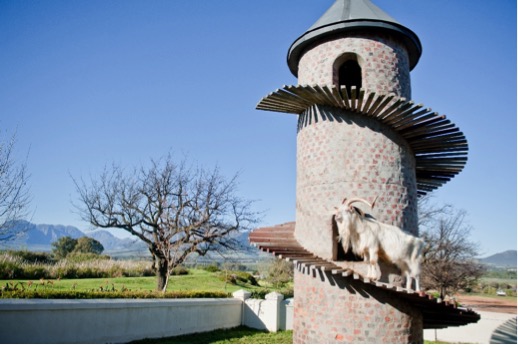
The real stroke of genius, I think, is their ‘Goat Tower’. It’s the talking point. It’s what people come to see while they relax in the sunshine over a few glasses of Chenin Blanc or Pinotage and some non-threatening food.
That’s all just the warm up, of course, for their tasting room experience…
What’s different about the Fairview tasting room? You will notice the unique shape of their tasting bars. They are designed so pairs of servers can stand back to back never missing eye contact with a customer and never able to attempt serving more than 6-7 people at a time. I counted 17 stands altogether on top to their extensive seated tasting areas. As soon as more people come in, they can simply scale up.
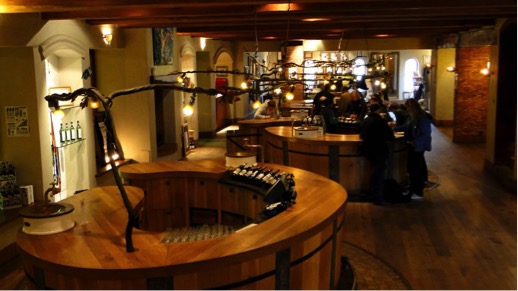
You will also note the directional lighting (so as to see the wine better) and the large spittoons. I don’t think there is anything more off-putting than having people mock you for asking for a spittoon when it is, after all – wine ‘tasting’.
One question I always get when I show this set up in workshops is “wouldn’t that be a nightmare having to have all of those bottles open all of the time?” If you look closely, you will see that the selections of bottles are in racks and have carry handles so that the whole lot can simply be transferred to another station.
Watch this video to see how one of our Australian clients then took this concept and put it into practice in a slightly different way. Using something similar to an old fashioned milk crate, Crittenden’s Wines can serve seated tastings across their estate using fewer people than they would do running backwards and forwards to the bar with individual bottles. These are small steps taken but put a number of these together and they can be transformative. I’m sure that you’ve all seen these numbers…
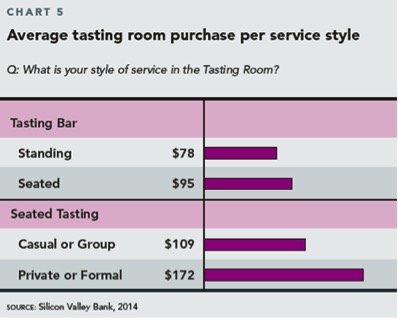
So what’s global best practice in terms of the actual tasting itself?
Caroline Martin of Creation Wines is a regular attendee of our workshops and is perhaps doing it better than anyone else in the world at the moment. You have to imaging that they are an hour and half from Cape Town up a gravel road that has a ten minute changeover traffic light in a country where you don’t necessarily feel safe as that transpires…
When you arrive, you see a car park that is always full, seven days of the week. As you will see on their web page, it iss wine and food paring done at a hither to unseen level that is what draws people in.
What are the absolute best operators doing in South Africa that I haven’t seen anywhere else?
- They start by selling to tour operators in inbound markets such as the UK, Germany and Holland.
- They create, ‘productize’ and sell an experience. In some cases, tour operators will even pay my clients to entertain their customers. (Sort of like Tom Sawyer getting his friends to paint his fence)
- They form full partnerships with restaurants and accommodation so as to control the visitor experience from end to end
- They, of course, look to deliver excellence at cellar door
- They continue to sell direct to customer using online shops and fulfillment operations based in international markets.
Your next question must then surely be - “Just how well do these sorts of ideas and practices transplant across international markets?”
Marc Dobson and Larry Jacobs moved to Australia from South Africa in 1997 and bought the Hahndorf Hill Winery in the Adelaide Hills. Larry was the founder of the much acclaimed Mulderbosch winery in South Africa but was little known in Australia. They quickly built a reputation as one of Australia’s best Cool Climate producers pioneering Austrian varietals in Australia but that’s not what made them famous. They negotiated exclusive distribution rights for ‘the world’s best chocolate’ and (here’s the clever bit) they don’t sell it. You must go to the winery to have the experience.
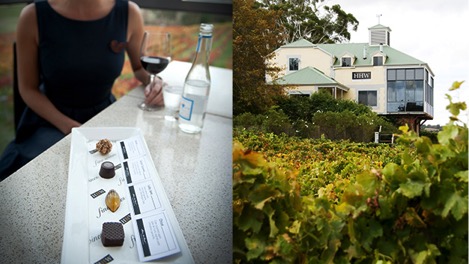
This was included in CNN’s ‘Top 10 global adventures for chocoholics’. It ranks in the ‘Top 10 food and wine touring options’ of South Australia. Hahndorf Hill was inducted into the Regional Tourism Hall of Fame after winning Best Tourism Winery in the Adelaide Hills for three consecutive years.
So it can be that simple. I’ve seen a lot of Barolo sold with a sharp knife and a roll truffle salami. You may never think to implement these types of innovations unless you see what happens in other markets. It’s a tough job but someone has to do it.